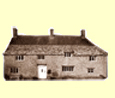
The Kinkedd Curse: 1899 - 1941 The Kinkedd family residence at Black River House came to an end with the death of Frances Montague Kinkedd in 1992, but to the people of Kildubhan their legacy remains as strong as ever. The foremost association with the family is that of substantial wealth and the employment of many residents of the village throughout the generations. However it is universally accepted that the price paid by the Kinkedds for their wealth and status was a history marked by tragedy and personal loss.
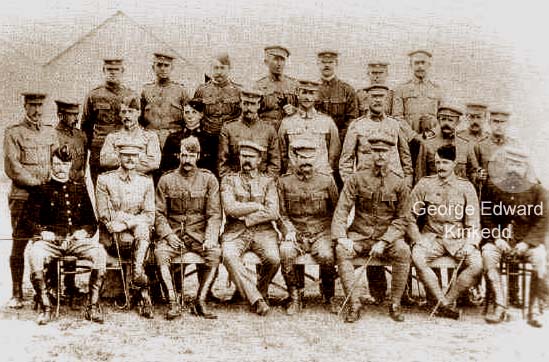
Towards the end of 1899 George Edward Kinkedd returned from the Boer War in a frail and weakened state. It was learned from his comrades that George had suffered a bout of Typhoid Fever and was alive only through the grace of God. He had been delirious for several weeks and had displayed a growing religious fervour during this time which was entirely absent from his nature prior to his active service. In particular George Edward is believed to have identified closely with the Crucifixion, believing himself to have been effectively "crucified" by his superiors on the battlefield. Although he recovered physically, his obsession grew stronger as he devoted more and more of his time to painting, sketching and carving detailed religious imagery much of which constituted graphically violent depictions of Christ's Death on the Cross. George sold some of these pieces and their curious repercussions are described on The Cycle of Events page. George gradually began to settle into civilian life but in 1901 tragedy was to strike as his wife Emily died giving birth to their second son Jacob. Although the death was never officially regarded as anything more than a cruel twist of fate, several circumstances surrounding It gave rise to the theory that Emily's death was more complicated than it seemed.
George's sanity declined rapidly after the death of his wife to whom he would refer only as "My Poor Sweet Love". This sentiment was chillingly echoed by the Black River House Murderer John Marchant who scrawled the same words above the body of his own murdered wife in November 1992. As if to mock any hopes of mere coincidence, the words were repeated once more on the walls of Black River House in 1996 by the vanished band The Secret Method. Within a few months of Emily's death, George Edward Kinkedd, broken and insane was buried alongside her leaving his elderly parents to raise his two sons. Many in Kildubhan still refuse to venture anywhere near the burial site believing that neither soul has found rest.
"The Thoughts of Yesterday" - A Polluted Legacy It is around this time that the legend of "The Thoughts of Yesterday" begins to emerge. The Kildubhan tradition suggests that Black River House is in effect still inhabited by every generation of the Kinkedd family. To treat the building as a "haunted house" would be to trivialise the notion, and more importantly it would be a misunderstanding. "The Thoughts of Yesterday" it is believed, do not manifest themselves as apparitions, rather they exist within the very walls of Black River House. It is strongly believed by many in Kildubhan, often to the point of refusing to discuss the subject, that the consciousness of the generations of the Kinkedd family possess an almost omnipotent presence, filling the building with the collective thoughts, fears and feelings of countless souls.
However a counter - theory suggests that the same presence in Black River House was effectively "polluted" or distorted during the life of George Edward Kinkedd. Within the space of two years the house witnessed the deaths of George, Emily and the infant Edward as well as the suspicious miscarriage of another child. Many in Kildubhan argue that the influence of The Thoughts of Yesterday was perverted from this point by the malign spirits of "Mad" George and his murdered wife and son, as well as the unborn child, widely believed to have been denied life at the hands of George Edward. The available evidence from later generations of the family and from the cases of 1992 and 1996 would currently suggest that this is the stronger theory.
Continuing Misfortunes: The War Years The case of George Edward Kinkedd, whether or not he and his wife found eternal rest may well be dismissed as an unfortunate turn of events were it not for the disturbing parallels which have in effect haunted each subsequent generation of the Kinkedd family. These parallels and their intricacies are dealt with in detail on The Cycle of Events page but an outline of the tragedies to befall George Edward's successors is given below. George Edward's eldest son Tom Kinkedd saw active service in The Great War, possibly injuring himself deliberately in order to return home in 1915. Whether engineered or not, Tom's wound did not heal easily and like his Father before him, Tom spent many months in almost constant delirium. During this time Tom also took to painting, in this case nothing but indistinct shadowy figures. When questioned about his work, Tom would often state that the work represented himself and his "brothers and sister". As has already been established Tom had only one Brother who survived beyond infancy but he also claimed to commune with the spirit of the dead child, and also that of the miscarried child to whom he referred mostly as "Emma" though one image of her alone was entitled simply "My Poor Sweet Love". He also claimed during this time to have recurrent conversations with his dead Father in which the latter confessed to the murder of his wife and brother. Tom regained his health and unlike his Father, reclaimed his sanity. In 1918 he emigrated with his wife Anne and the younger of their two sons to Australia. The younger son Robert who had never coped well with his Father's mental difficulties remained in Ireland after fiercely insisting that he stay with his Uncle Jacob. Tragically for Tom the journey to the other side of the globe did not set him free from the Kinkedd curse and Anne died almost immediately from smallpox, a disease she is believed to have carried with her from Ireland. The remainder of the family stayed in Australia and beyond this point no clear records are available.
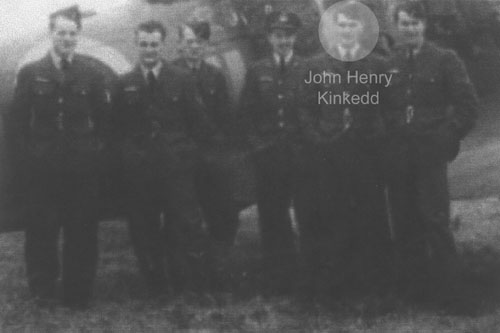
Persistent Retribution: 1949 - Present The death of Jacob Kinkedd marks a truly significant chapter in the history of both Black River House and the Kinkedd family. Though not immediately apparent, his daughter Frances would be the last resident of Black River House to bear the Kinkedd name. Under Frances the Black River House estate finally ceased to be a working farm and with the considerable fortune amassed by her Father she opted to pursue her career as an artist. Despite her success in this field she also faced her share of tragedy. Frances was hit very badly by the loss of her Brother in 1941, as a young woman of twenty, her elder Brother had been the foremost male figure in her life and his loss was a devastating blow. Displaying the same mental fragility of her forefathers, Frances fell into a depression so deep that it was for some while treated as a more serious mental illness. Frances was already a painter but at this time, recalling the characteristics of George Edward and Tom Kinkedd, she began to paint voraciously to the exclusion of all other aspects of daily life. Over a period of three years she painted an endless series of images which bore a striking resemblance to the shadowy figures preferred by her uncle Tom. These she simply referred to as the "sibling" paintings and when questioned she would state only that the pictures, always of four child like shapes of various sizes, depicted three brothers and a sister, in mourning for one another's souls. Frances began to recover with the arrival of future husband John Mahoney who tended her every need throughout her recovery. In 1947 the couple were married and three years later they had their first son, Brian. A daughter, Tara, followed as did several years of happiness and wealth. However the spectre of tragedy would rear it head once again in 1977 when Brian, a rising musical star was killed in a head on collision with another vehicle less than 200 yards from Black River House. Whether or not "The Thoughts of Yesterday" have any basis in reality, what is certain is that the concept exists in the very foundations of Kildubhan. While the presence of deceased members of the Kinkedd family is not in itself regarded as a malign influence, it is clear that the family suffered disproportionate amounts of personal tragedy throughout the centuries, in some cases leading to cases of near insanity. It was this environment into which the outsider John Marchant and his family were to step at the beginning of 1992. One might speculate as to which was the more dangerous, inhabiting a House believed to be permeated with the spirits of its dead inhabitants, or existing in a remote and insular village with immovable superstitions surrounding the House and its family. In whichever case, the tragedy of Black River House was to repeat itself again.
|