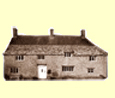
Black River House stands bleak and solitary on the Eastern bank of the Black River, (Gaelic – Abhainn Dubh) as it flows through the tiny village of Kildubhan. Known locally as “Old Man Black" or "The Dark'un" this slow flowing waterway winds its way through Munster Before eventually finding its way into the Shannon Estuary. The main structure of Black River House was built by farm workers around 1690 AD and for almost three hundred years the building was home to several generations of the wealthy Kinkedd family as well as a place of work for many of the local people. The dependence of the people of Kildubhan on Black River House throughout the generations has resulted in a complex web of history in which it is often impossible to separate the fate of the village from that of the house itself. Up until its purchase by John Marchant at the beginning of 1992, Black River House had been continually inhabited by an unbroken line of the Kinkedd family. Records of the house before the eighteenth century are sketchy but it can be established for certain that Abraham Shem Kinkedd, born in 1735 was brought into the world within the walls of Black River House. Abraham Shem Kinkedd is known to have had a strong English ancestry but what has only recently been discovered is that it was not until Abraham's adult life that the name Kinkedd appeared at all. Abraham's surname at birth was Kidd, an old English name relating, unsurprisingly, to livestock. It is now known that Abraham changed his name during his adult life, in an attempt to immerse his family in the local culture. He added the prefix "Kin" which was already present in Irish Gaelic, referring to a notable landscape feature - a headland or a promontory. He was also able to take solace in the English usage of "Kin" to mean family. It is thought that he also softened the vowel sound from "kidd" to "kedd" in an effort to imitate the softer, more lilting tones of the Irish tongue. Thus, one of the oldest and most revered surnames in the area is in fact the creation of one man. One might draw a disturbing parallel between Abraham's attempts to integrate with the local way of life and the efforts of John Marchant to do the same more than two hundred years later.
Salvation of the Community: 1847 - 1900 The history of Black River House and the Kinkedd family comes into sharper focus in the mid nineteenth century when the family begin to emerge as a respected pillar of the community. The village of Kildubhan was at this time, and remains today, an almost exclusively agricultural community based on a handful of small farming families. Given the near isolation of Kildubhan the Great Potato Famine struck a deadly blow with its arrival in 1845.
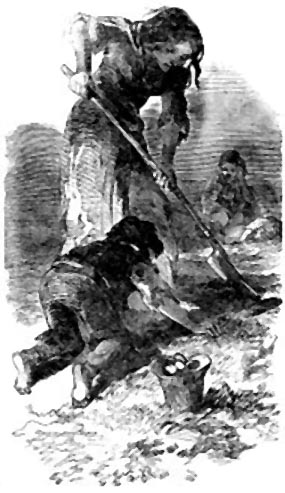
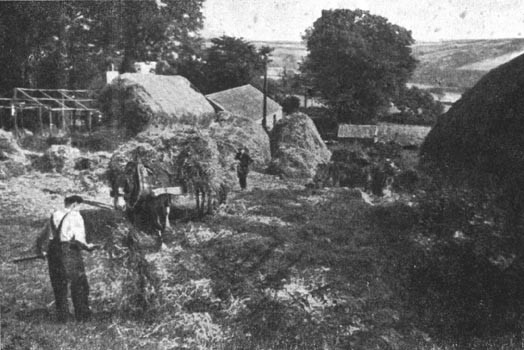
At this time an antipathy for the English was growing in Ireland, for whilst the potato crop had utterly succumbed to the blight, other crops farmed by wealthy establishments such as Black River House prospered. Wheat and Oats performed well and whilst they were in abundance the Irish-English landlords shipped their entire produce to Europe where a better price could be commanded. Ship after ship left Irish ports loaded with food while the people of villages like Kildubhan starved. Henry Saul Kinkedd presented a refreshing exception. In 1847 he stopped his exports to Europe and diverted his produce to Kildubhan and the surrounding area in return for labour from the local people. It is noted that although the people were effectively working for food, their benefactor paid them very generously and it is argued to this day in Kildubhan that had it not been for Henry Saul's noble gesture, the village would have simply ceased to be. The gratitude felt by the people of Kildubhan towards Henry Saul was demonstrated when he left to fight in the Crimean War in 1854. Henry returned two years later to find that the villagers had continued to take care of the farm and that the estate was more prosperous than when he had left. So successful was the practice of the residents of Kildubhan working on the grounds of Black River House, that it continued unabated for more than fifty years. In this way the village was able to navigate Ireland's long recovery from the famine in a relatively privileged position.
Hard Times: 1900 - 1918 Henry Saul Kinkedd's only child George Edward did not carry on his Father's generous legacy. George returned from the Boer War in 1899 a broken man. Having only engaged for a few months George had been stricken by Typhoid and returned to Kildubhan in a state of delirium which would last in varying degrees of severity for many months. George had never been regarded as anything other than a worthy successor to his Father. He was a bright and promising young man who was only too happy to continue the Kinkedd family's proud military tradition. Up until 1899 Henry Saul remained the head of the Black River household but while his son was away his health declined sharply. He saw fit to pass the estate to his son while he was alive in order than he might watch his heir take the estate from strength to strength. He little expected the shadow of a man who returned from action. George Edward soon earned the nickname "Mad George" when at the beginning of 1900 he dismissed the entire staff of Black River House at a moment's notice. Servants, maids and farm workers were swept away in a single gesture with George proclaiming that Black River House was closed for business. For almost two decades Black River House stopped functioning as a farm altogether and the Kinkedd family under the erratic control of George Edward withdrew from public life completely. During this time George's mental health ebbed and flowed as he occupied himself with painting and carving religious imagery. George's behaviour is more thoroughly explored in A Tragic History but its effects on the Kinkedd family's standing in Kildubhan were not positive. The final seal on the reputation of "Mad George" came with the death of his wife Emily Anne in 1901 during childbirth, a tragedy which many believed was the deliberate work of her husband.
A Return to Prosperity: 1918 - 1949 Black River House saw a return to prosperity and normality after 1918 when George's Son Jacob Kinkedd returned from action in the final months of The Great War. With the emigration of his Brother Tom, Jacob became the head of the household and resolved to restore the reputation of Black River House and the Kinkedd family to their former glory.
Jacob continued to raise the profile of the House up until the death of his son John Henry in 1941. For the rest of the war the heartbroken Father consoled himself by throwing himself into farm labour. He continued to work on the Black River House estate despite his considerable personal fortune up until his own death in 1949.
Slow Decline: 1950 - 1992 The death of Jacob Kinkedd left Black River House in the hands of his daughter Frances Montague Kinkedd and her American husband John Mahoney. It also marked the beginning of the final decline in status of Black River House and the Kinkedd family in Kildubhan. Under Frances Montague Kinkedd Black River House ceased once more to be a working farm although this time it was handled with more diplomacy and grace than George Edward Kinkedd had demonstrated in 1900. The farming capacity of Black River House was slowly wound down until by 1952 the property was simply a private residence. Frances took a long time to recover from the death of her Father and Brother and with a young son and later a daughter, she had neither the time nor the inclination to continue working. Her fortune had been established under her Father's control of the business to such a degree that she was able to break with the farming history of Black River House completely and pursue her career as an artist. Nonetheless Frances' time in the House was not a happy one and with the death of her son Brian in 1977 and the emigration of her daughter Tara to Switzerland the same year, the occupants of Black River House were reduced to just two. John Mahoney died in 1988, and four years later Frances Montague Kinkedd passed away leaving the house empty, but crucially leaving no Kinkedd resident in Ireland to take her place.
Recent History: 1992 - Present The Black River House Murders of 1992 and The Lost Band case of 1996 are discussed at length in their respective sections. However the key point to note is that 1992 marked the arrival of the first residents of Black River House to bear a surname other than Kinkedd. John Marchant was the first and last official resident of Black River House who did not have any physical connection to its history, although from the evidence recovered at the scene of the murders in 1992, it seems clear that the history of the house had been more than a passing interest for him. Since the disappearance of all three members of The Secret Method in 1996 the house has been firmly closed to the public. Occasional field trips have been sanctioned by the Irish Authorities, my own included although it has to be said that permission for such activities is becoming increasingly difficult to secure. In May 2005 another young musician managed to gain access to the house where he is believed to have survived for around a week. However once again tragedy was to strike, and the young man, Martin Edwards was found dead. It should be observed that Police were satisfied that this incident was one of suicide and unlike the cases of 1992 and 1996 there appear to be no unexplained circumstances. Martin Edwards was also discovered to have a long history of clinical depression and more strikingly, an obsession with everything relating to The Black River House Murders. However the lapse in security and the resulting death of a young man made the already nervous Authorities adamant that the house should remain closed permanently. I am currently in negotiations to make another field trip to Kildubhan in early 2006. I will certainly visit the village as I feel that there is much more to be learned from the area and its residents. However I am uncertain as to whether permission to the house itself will be granted. I have a good relationship with the relevant Authorities and of course this web site carries some weight, but since 2005 the security has been almost fanatical and I am left in some doubt as to when, if at all, I will be able to visit the house again.
|